
Beachcop
A retrospective on the troubled series ahead of the upcoming film revival.

This post is by guest writer Chiff Adams, who writes regular media reviews for the Southwest Daily Herald-Gazette1.
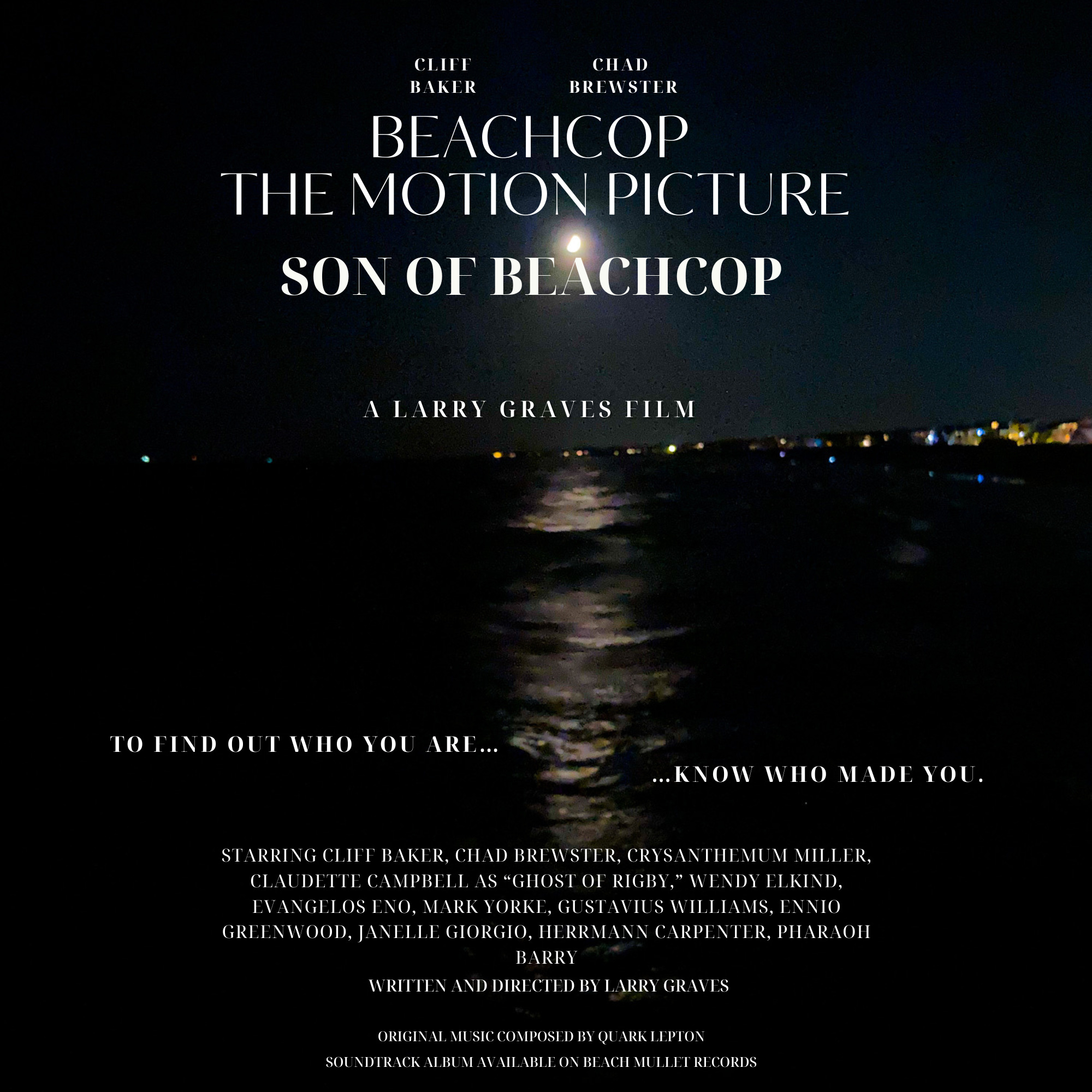
In anticipation of the upcoming Beachcop feature film, we’re revisiting this little-seen network oddity. Significant spoilers for all four seasons of Beachcop ahead, so read at your own risk.
What makes a cop show “good”?
Specifically, the kind of early-evening police drama whose fondest dream is generating enough episodes to qualify for syndication and late-night re-runs?
It’s not saying anything new to suggest that television shows often represent a heightened struggle between art and commerce. The philosophical dilemma of the TV critic is, should we judge a show on its own terms, on what it has set out to do, or should we hold to some higher ideal of aesthetic or emotional or even moral value? (Or should we just tell people whether it’s worth spending their time watching one show, instead of another?)
Particularly during the pre-streaming era Beachcop inhabited, that last answer is probably the one most readers of TV reviews and recaps would have chosen.
Beachcop, the late primetime procedural, lacked many things.
An original hook. A talented cast. A large budget. A consistent directorial vision.
But then, it wasn’t trying to be NYPD Blue, or Homicide. Or even Miami Vice, although the soundtrack of that last show was clearly an influence.
What Beachcop had was a troubled production history that turned it into, if not a “cult classic,” at least a kind of cult artifact— if not the object of cultlike adoration, at least an object created by a bunch of crazy people.
In its first season, the show took on familiar tropes of ‘80s and ‘90s cop shows the way a rusty boat takes on barnacles.
In the first several episodes, a small-town beat cop-turned-detective tries to solve ocean-adjacent crimes. (Think Baywatch Nights but with less of the camp that made such an enterprise bearable.)
The protagonist (bizarrely unnamed throughout the entire series, as if he is Clint Eastwood in a Sergio Leone Western, but in the body of a cut-rate Magnum, PI) works hard, drinks hard, fights off hangovers, and tries to stay out of hot water with the local chief of police.
The season gets its only real jolt of energy (such as it is) in a plot point ripped straight from Top Gun or countless tough-guy actioners of the era: “Beachcop’s” partner is killed by a serial killer in a dance club, driving the protagonist— of course— to more drinking and more hangovers, but also to enough genuine grief to almost bring authentic pathos to the show. Beachcop (the character) may not care about rules or procedure or good police work or hygiene, but he really, really, really cares about his partner.
Still, not exactly groundbreaking stuff.
It’s the second season where things get weird, and not necessarily for reasons justified by the plot.
Showrunner Larry Graves, it turns out, had been injecting more than a few autobiographical details into the show.
Of course, Graves’ struggles with substances and mental health issues are by now, if not legendary, at least infamous. But at the time, Graves’ output as a headwriter and showrunner on network sitcoms and low-stakes dramas had been so by-the-numbers that he seemed like a reliable, if unremarkable, content generator that the network could safely keep around until retirement.
Less a passionate Ed Wood type than a slightly bored, highly competent corporate trustee. Graves was someone who would make sure episodes came in on time and under budget. A capital-A Artist he was not.
But during Season Two, a different side of Graves— one that probably wouldn’t have stayed hidden nearly as long in the social media era— came to public view. To put it mildly, Graves made the mistake of mixing booze, antidepressants, and too much grad-school-level political and social theory.
It’s as if Graves had never heard of police brutality or corruption until immediately after Season One.
The result was a series of episodes that bore little resemblance to the ones that preceded them. What had been a paint-by-numbers police show turned into something, if not richer, at least much stranger.
In the show’s second season, “Beachcop” (the character) suddenly becomes somehow self-aware, while the show seems to retreat further from any kind of awareness than ever before. Replacing the sunny, sandswept crime scenes and all-night benders are strange philosophical interludes.
Car chases are replaced by dark nights of the soul.
Gun fights morph into long pseudo-Dostoevsky dialogues— which then morph into gunfights.
An entire episode is filmed in black and white for some reason.
The main character becomes tortured with the idea that he is part of a system intended not to bring justice (or beat up the occasional villain) but to perpetuate a cycle of incarceration . (In case the viewer has somehow missed the onslaught of Big Messages, at one point, teenagers drive by in a car blasting an incongrous motorik beat song with lyrics about “building a panopticon from sea to shining sea”).
As Grave’s personal life evidently traveled further and further off the rails, he became Season Three’s only writer.
Leaving behind the occasional black and white of previous episodes, episode color palettes began to resemble something out of a Dario Argento film. The ocean became a big, imposing, cerulean blue metaphor for… something that never really became clear.
The protagonist of Beachcop now mostly abandoned regular police work, and recurring characters from early episodes started to appear less and less frequently; instead, “Beachcop” plumbed the depths of an apparently sinister Corporation (a plot detour that mostly consisted of the character breaking into empty office buildings in the dead of night).
He drank more than ever, but rather than the personal malaise of grief, what was driving him became more and more inscrutable and esoteric.
(Major spoilers ahead.)
And then he died.
It’s unclear whether Graves, given one last season by a network that apparently had money to burn, was trying to go out in a blaze of glory or in a ball of fire.
In any case, in the very first episode of the season, the somehow-even-more-alcoholic protagonist wakes up on a beach and promptly quits the police force.
Within three episodes, “Beachcop” is dead, killed during his final high-speed chase with a car that is perhaps a ghost, perhaps the man who murdered his long-dead partner, or perhaps another metaphor for something that would be fascinatingly ineffable in the hands of a better team of filmmakers.
The remaining episodes were sometimes totally indecipherable, as Graves and his crew generated images that suggested Beachcop’s soul traveling to some kind of afterworld, or transcending reality altogether.
Endless bridges, the expanse of space, and other on-the-nose (and 2001: A Space Odyssey-indebted) images fill the last several episodes, which bring to mind other puzzling season enders like Hideaki Anno’s End of Evangelion or David Lynch’s Twin Peaks: The Return.
But where those series saw complicated auteurs working out profound personal visions and taking large creative risks, Beachcop had a guy who maybe should have stuck to standard network genre fare and gone to a good therapist trying to make art, instead.
Now, somewhat inexplicably, Graves is back with a mid-budget theatrical feature continutation of a series that had apparently been lost to time and indifference. It’s unclear if this is something fans were clamoring for (or if the show currently has fans), and it’s not totally clear why a series that spent an entire season on its protagonist’s death and total narrative resolution felt it needed a movie to finish out the story.
I’ll give the film this: based on previews, the painfully-titled Beachcop: The Motion Picture: Son of Beachcop seems to at least be brave enough to stick to its convictions.
Instead of retconning the series’ ending (remember Highlander II, anyone? Neither did the filmmakers of Highlander III!) or explaining away the death of his protagonist and only consistent character, Graves seems to be doubling down.
Imagery from the trailers show more (and weirder) abstract, spacey imagery, as well as a narrative that features a protagonist who isn’t even a police officer (but who may be, judging from that overly long title, a long-lost descendant of the titular dead hero).
It also seems like they might have finally shelled out for an orchestra (or at least a more convincing facsimile of one than the last four seasons of what one reviewer called “weird endearing, electronic indie-pop”) for the soundtrack.
It may be too much to hope that it will be “good,” but let’s at least hope it won’t be boring.
Editor’s note: After this article’s original publication, the film’s release date was pushed back indefinitely. The soundtrack doesn’t seem to have a wide release date, either, but it is available on Bandcamp (see below). While the television series never achieved syndication, and isn’t currently available on streaming or physical media, the show’s soundtracks were re-released starting in 2019, and are available pretty much everywhere. Perhaps they’re the best way to get excited for the movie.
And, who it should be said, is not a real person.
 | A guest post by
|