Why Can't SC Officials Write Their Own Bills to Destroy Education?
A Letter to the SC Education and Public Works Committee
Thank you for reading! This work is possible because of subscribers and donors.
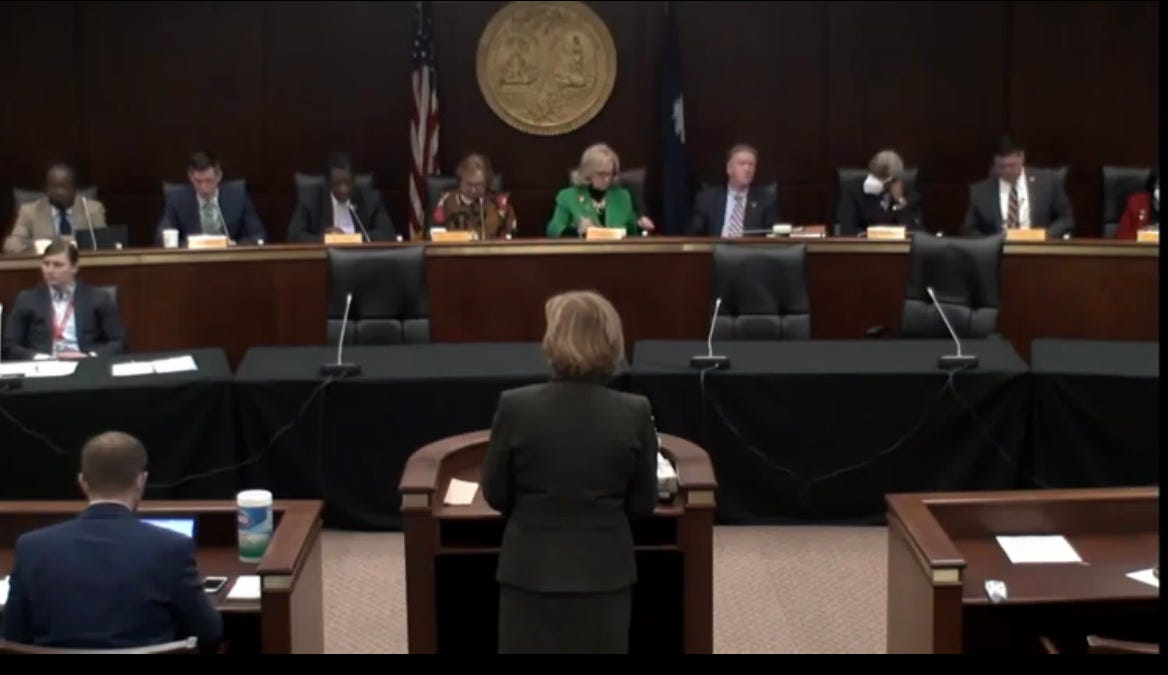
The following is closely adapted from written testimony I sent to the members of the South Carolina House Education and Public Works Committee, which is meeting tomorrow, February 16, 2022, to discuss a series of what the state NAACP and ACLU have called “anti-truth bills”. If you are reading this before February 16, please consider emailing the Committee at GingerLee@schouse.gov to share your concerns.
Note: As of March 5, I have made some updates to better reflect the current language and discussion around the bill.

I wish I could be at tomorrow's meeting in person, but as the Committee has scheduled this meeting during the school day and I am out of personal days, I cannot attend. Even if I could, I would be reluctant to leave my students at school while we are having a serious sub shortage, even though I am also very concerned about the real harm some of the bills being discussed could do to my students and to their educational opportunities. I am sure this is an issue for many other teachers, administrators, school staff, parents, and other stakeholders in public schools, I hope that the Committee will allow for other forms of public testimony that could include these stakeholders.
I'll briefly run down some more specific logistical issues with each of the bills being considered, but first let me say that the provisions on prohibiting schools to require the teaching of current events and prohibiting students from getting credit for civics-related projects seem to me to be particularly bizarre and counterproductive. For example, if H. 4392 had passed before a few weeks ago, it would have been potentially a violation of the law for me to have Senator Greg Hembree come and speak to my students, because he had an open dialogue with them that included discussion of South Carolina legislation. Does this count as "lobbying" under the definition of the bill? Because he came during a class which they were required to attend, am I then requiring them to engage in “lobbying for legislation at the local, state, or federal level”? The language of the bill is unclear.
Similarly, the idea of teaching a social studies course, especially, without covering current events, is disturbing. I think the reason for these provisions, which few in South Carolina would have ever requested, is that instead of writing an original bill to address any real issues which may be occurring, representatives sponsoring bills like H. 4392 have opted to copy from out-of-state think tanks instead. To give just one example, almost all of the text for H. 4392 comes from NAS, a right-leaning think tank whose leaders have been involved in a number of controversies involving Texas schools and even the US Supreme Court. Why couldn't legislators in SC have written their own bill, or even substantially modified this model bill, if these issues were truly important to South Carolinians?
I'll include some brief thoughts about each of the other bills up for discussion below. Links are provided in the heading of each section.
While prohibiting racist and sexist statements by teachers is a good thing (and something which Title IX and state regulations already do), there is no reason to tie this to "Critical Race Theory" in the way the sponsors have done. The bill, as currently written, says teachers may not "direct or otherwise compel students to personally affirm, adopt, or adhere to the tenets of critical race theory; or..." That or does a lot of heavy lifting because the bill does not define the "tenets of Critical Race Theory" but merely prohibits discussing them, along with a series of objectionable ideas. This wording opens teachers up to being accused of violating the first part of the bill by addressing almost anything anyone could argue is related to "CRT". It is striking that we are one of only two states which has not passed a hate crime law, yet legislators feel the need to insert this language in a way that makes it very difficult to know which concepts are off-limits for teachers.
4605
Again, while statements protecting student "freedom of inquiry, freedom of speech, freedom from compelled speech, and freedom of association" are obviously valid and helpful (and, again, already covered under Title IX and state law), the bill goes on to limit the kinds of conversations students and teachers can reasonably have in schools. Students need to feel free to speak with trusted adults about concerns they have about their own health and well-being, and this bill would chill those discussions. While, again, no teacher should be trying to brainwash or coerce students, the bill, as written would seem to make it very difficult to even discuss common topics that are important to students, such as gender discrimination.
While I appreciate that this bill at least does define what the sponsors believe are the "tenets" of CRT, it also creates unnecessarily burdensome paperwork for schools, districts, and teachers. I already post all of my agendas and lesson plans online through our district LMS, which parents of students enrolled in the courses can easily access. If you speak to a representative sampling of parents across the state, I don't believe they perceive a lack of transparency. I also, again, have a serious issue with bills claiming to be about avoiding partisanship and ideological coercion taking their definitions of CRT from partisan political sources such as Heritage Foundation. This link, for example, shows that the bill copies word-for-word much of Heritage's model bill. I believe most stakeholders in public schools would like for elected districts and the South Carolina Department of Education to make curricular decisions, not an out-of-state think tank.
Again, the goal of having nonpartisan curricula is a good one (and one I believe most if not all districts are already doing a good job of pursuing). This bill prohibits the use of the 1619 Project (a broad set of materials that includes, among other materials, poetry from Sour Carolina post Nikky Finney). (A companion Senate Bill, S.534 goes even further by requiring that curricular decisions in South Carolina be aligned with The 1776 Report, a politically-motivated and reactionary report with no input from South Carolina officials, history teachers, or any US history experts, is about as partisan as it gets.) We have a lengthy process, required by statute, to create our history and social studies standards. I have worked on English Language Arts standards, and find it offensive that legislators are second-guessing the hard work of educational professionals in creating standards, and second-guessing the public's input into the textbook selection process, by requiring alignment with a Washington insider report. These and other reasons led many groups of historians, such as the American Historical Association, to reject the 1776 Report and 47 co-signing organizations, as "a screed against a half-century of historical scholarship, presented largely as a series of caricatures, using single examples (most notably the “1619 Project”) to represent broader historiographical trends". If the sponsors feel the 1619 Project is overly partisan, and if their solution is to simply replace one partisan document with another, this would seem to refute the claim that the goal is unbiased history. (Of course, a better solution would be to acknowledge that the study of history requires the analysis of many different perspectives, and to allow teachers and curricular experts to do the job they are paid to do, and select materials as needed to teach real students in real schools.)
Thank you for your time an attention. Again, I hope that the meeting is constructive and that there is an opportunity in the future for educational experts, parents, and other stakeholders to be involved.

