
What is power?
South Carolina's gerrymandering push illuminates the nature of power

A note about this newsletter: the nonprofit sources of funding for many of these pieces have come to an end. If you’re able to subscribe at any level to help the newsletter continue, I appreciate it!
I also think, that one of the side effects of this is, very candidly, you’re going to motivate Black turnout, and there will be repercussions for that. There will be down-ballot repercussions.
—South Carolina Republican Senate Majority Leader Shane Massey
O’Brien: “The object of power is power.”
-George Orwell, 1984
In the wake of the Supreme Court’s 6-3 ruling in Louisiana v. Callais, and after direct demands to do so from President Trump, South Carolina’s GOP majority predictably rushed headlong into a conflict over whether to re-draw South Carolina’s heavily gerrymandered Congressional map. The goal is clearly to make a heavily gerrymandered state even more gerrymandered, with particular focus on eliminating the district of South Carolina’s only Democratic U.S. House member, James Clyburn (who is seen as a major factor in former President Biden’s nomination and ultimate defeat of Trump in the last election).
Plenty has been written, rightly, about the implications of eliminating a majority Black district in a state in which Black legislators make up a disproportionately small percentage of the General Assembly, and where— based on US Census data— Black people make up over one out of every four people of the state, but where only one House district in the state (out of seven) is represented by a Black person.
But there’s also more to say about what these kinds of political moves say about the nature of power, how the drive for power can subsume the supposed purpose of elected representation, and how undermining voting rights can destabilize society in ways that harm us all, including those doing the undermining.
In his 1963 essay “A Talk to Teachers,” James Baldwin wrote that, “there are in this country tremendous reservoirs of bitterness which have never been able to find an outlet, but may find an outlet soon.”
Baldwin called post-Civil War Reconstruction a “bargain” in which Black Americans were “liberated from the land” only to be “delivered to the bosses”. Baldwin argued that America, in 1963, because of its treatment of Black Americans, because of its distortion and denial of its history, and because of the falsity of its educational promises about the “land of the free,” was “dreadfully menaced... from within”.
And ultimately, the primary threat was not simply violent revolution— an obsession of Cold War-era America— but the undermining of the supposedly democratic values that could hold the country to together, by the hypocrisy and lawlessness of both Jim Crow racism in the South and hypocritical fantasies of a “free country” in America while people of color remained objectively oppressed.
It’s easy to imagine that without the passage of the Civil Rights Act the next year and the Voting Rights Act the year after that— bills brought into being by the tremendous efforts of Civil Rights protesters— those reservoirs of bitterness wouldn’t have justifiably resulted in an even more complete disillusionment from the democratic process, both for marginalized people and for anyone with their eyes open to reality. After all, if an entire population can’t vote, if they can’t learn about themselves in school, if they can’t walk freely down the street without harassment, if they can’t live for fear of being lynched, and if they can’t protest for fear of being arrested or beaten by the police, what incentive would they have to continue to productively and peacefully participate in society, and what incentive would any thinking person have to believe they couldn’t be next?
Sadly, in 2026, the same questions are equally pressing.
I think Baldwin, unsurprisingly, understood something which gerrymandering legislators in South Carolina have either forgotten or pretended to forget (if they ever understood it at all).
It’s something that Massey, with a characteristic kind of weasel-y wisdom, does seem to understand.
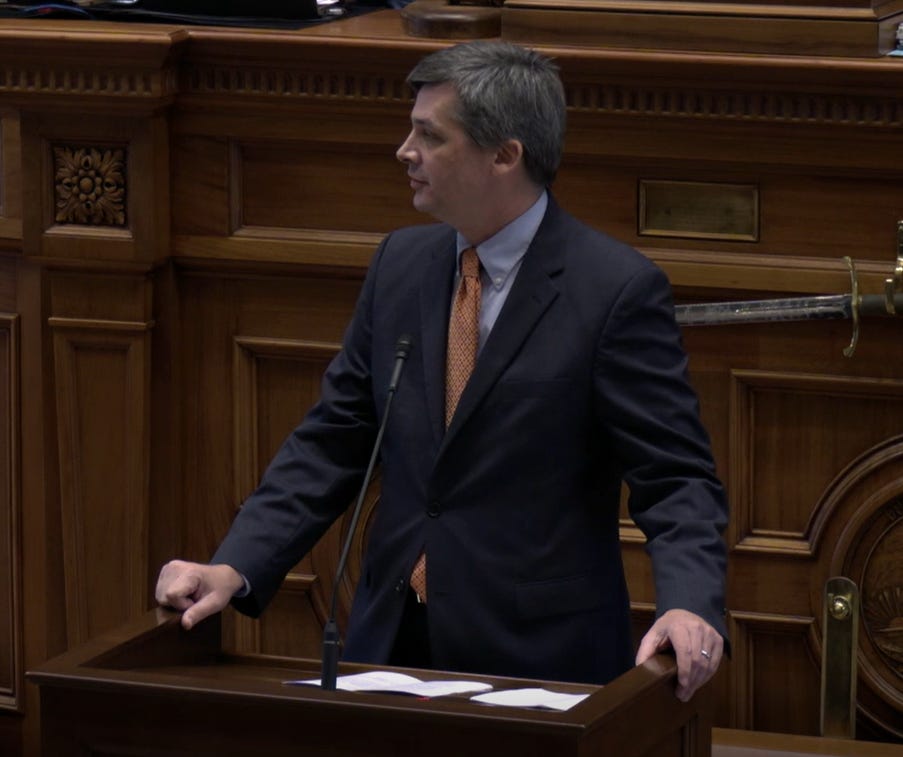
I think Shane Massey, when he delivered his remarks on why he voted against the current gerrymander rush in SC, revealed a deep, if unconscious, understanding of how power works that dovetails, in a funhouse mirror way, with Baldwin’s.
Massey, too, seems to believe that if you push voters too far, they will revolt.
And, for what it’s worth, Massey did also argue that “state are sovereign and independent creatures” and that presidential executive power had become too broad. Notably, Massey has also in the past said he is “not a lowercase d democrat,” and that elected officials— elected in a gerrymandered process— set policy once they “won some freakin’ elections”.
In short, Massey has gotten a lot— arguably too much— credit for “standing up” to President Trump (something he linked in his speech to being proudly “Southern” in a way that, intentionally or not, recalls “states rights” revisionist history about the causes of the Civil War). But his stance should be considered in light of the fact that the current status quo has made Massey arguably the most powerful man in South Carolina politics, because he leads a party which has enjoyed sustained single-party control of every branch of state government through its past, avowed, used of partisan gerrymandering.
As Massey recently put it himself, after the state prevailed in a state Supreme Court case over its last redistricting effort by explicitly arguing it gerrymandered districts to make them winnable for Republicans, “We worked hard to ensure that South Carolina’s districts reflected the politics of South Carolina’s voters”.
In addition to whatever ideals about “republican” government he might or might not truly hold, Massey did voice explicit concern that more gerrymandering risked losing seats in future elections, partly because of increased voter turnout among Black South Carolinians.
Let that last part sink in for a moment. What kind of representative government do you believe in if you explicitly argue that your plans for it will be thwarted by more Black citizens voting?
For Baldwin, in 1963, the possibility that democratic society could be “dreadfully menaced” in response to a feeling of deep disenfranchisement seems to have been much more specific and material.
And if he was right, it was another compromise, like Reconstruction’s brief compromise, that avoided, for better or worse, a more profound uprising and revolution that what America ultimately saw in the 1960s.
When Ronald Reagan signed the reauthorization of the Voter Rights Act in 1982— if perhaps only under pressure from Civil Rights advocates— he seems to have realized, if reluctantly, that compromise was necessary. Black voters were certainly not a key part of Reagan’s constituency, but they were still Americans. As Reagan said at the signing ceremony,
Citizens must have complete confidence in the sanctity of their right to vote, and that's what this legislation is all about. It provides confidence that constitutional guarantees are being upheld and that no vote counts more than another. To so many of our people—our Americans of Mexican descent, our black Americans—this measure is as important symbolically as it is practically. It says to every individual, "Your vote is equal; your vote is meaningful; your vote is your constitutional right."
Political “power” is only a shadow of real power. Like the lines on the road, policies only work if they change behavior. Like the roads themselves, policies only work if they are in some way materially realized. In a society striving towards democracy, that real power can come in the form of influence over policies that materially impact people’s lives. In that way, a legitimate vote is a real power. But of course a vote cast in a race with a foregone conclusion, like a vote that isn’t counted, is all but meaningless.
When the vote becomes meaningless, much of that real power becomes even more material. And that creates the danger of both violent struggles for control, and an undermining of the “lines on the road” aspect of laws and policy: if no one acknowledges its reality, then “civilization” becomes unreal.
In Orwell’s 1984, Party member O’Brien tells his Winston, during an explanation of the Party’s view of “power,” “If you want a picture of the future, imagine a boot stamping on a human face— forever.” Unfortunately, in a society without the consent of the governed, without compromise, without enfranchisement, naked power isn’t just represented by political machinations, but by violence.
It’s important to remember that, to the extent his observations were correct, Orwell’s novel was a reflection of recent and current events in the dictatorships of Hitler’s Germany and Stalin’s USSR (as well as of the concerns of its primary inspiration, Yevgeny Zamyatin’s WE, which reflected the anxiety of growing repression under Bolshevik rule in the early 1920s).
It’s even more important to remember that before the war, Germany was a constitutional republic, and Russia was something like a parliamentary monarchy whose move further into autocracy was a major driver of the Russian Revolution. It’s not that fascism or totalitarianism are inevitable, but that there is a danger people will allow their governments to become too powerful to check.
And it’s important to note that as they build up power, out-of-check governments employ physical violence.
As Ta-Nehisi Coates writes in Between the World and Me,
But by now I am accustomed to intelligent people asking about the condition of my body without realizing the nature of their request. Specifically, the host [of a popular news show] wished to know why I felt that white America’s progress, or rather the progress of those Americans who believe they are white, was built on looting and violence. Hearing this, I felt an old and indistinct sadness well up in me. The answer to this question is the record of the believers themselves. The answer is American history.
South Carolinians, of all people, should know that Coates is right.
After all, our state erected a statue of “Pitchfork” Ben Tillman conspicuously in front of the State House in 1940, clearly as a way to terrorize Black citizens during the Jim Crow era.
Tillman openly, famously, and explicitly tied power to physical violence against Black South Carolinians.
In a 1909 speech, according to the Charleston Museum, Tillman recalled his participation in the Hamburg Massacre, a brutal and murderous raid carried out by the white supremacist Red Shirts against a lawful militia group protecting the majority-Black village of Hamburg. The Red Shirts ultimately executed six unarmed men at the end of the conflict.
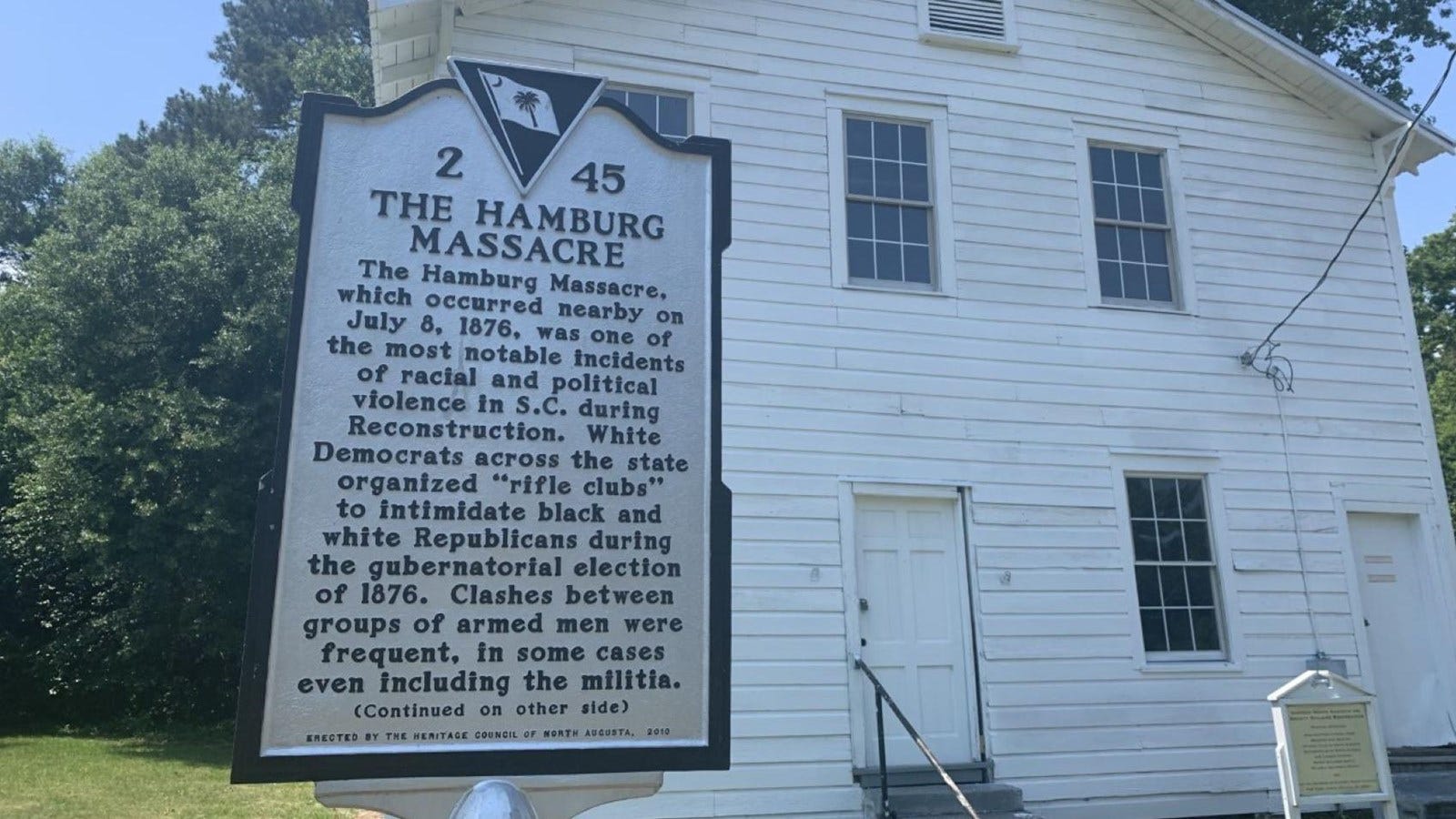
Tillman said in the speech that the Red Shirts’ goal was to “seize the first opportunity that the negroes might offer them to provoke a riot and teach the negroes a lesson….nothing but bloodshed and a good deal of it could answer the purpose of redeeming the state from negro and carpet bag rule.”
And so of course it’s no coincidence that Tillman also said,
We [South Carolinians] did not disfranchise [sic] the negroes until 1895. Then we had a constitutional convention convened which took the matter up calmly, deliberately, and avowedly with the purpose of disenfranchising as many of them as we could under the fourteenth and fifteenth amendments....
For Tillman, physical violence was power. Disenfranchising Black Americans, who had earned elected office and lawfully elected representatives under the same system that gave him his office, was also power. The law— specifically the lawful creation of a Black militia or the Constitutional amendments legally freeing enslaved people— constituted, for Tillman an obstacle to power.
Tillman’s view of power was, in modern terms, fascist (and of course it is: the Nazis used the Jim Crow South created by people like Tillman as a model for its own “final solution”). The inconsistency and hypocrisy with which he sought to wield it is the undergirding worldview of fascism: power at any cost. Power for White Americans at the expense of Black Americans. Power achieved through violence at the expense of the law. Power achieved through disenfranchisement at the expense of democracy.
The consequences in our present moment seem clear: is not only morally and ethically wrong to strip political power away from a quarter of the population, but it’s also destabilizing. Civilization is built on compromise, and there is no way for one person, one group, one party, or one organization, to grab at anything close to total power without causing the destruction of the ideals that hold together “civilization”.
In the ancient Greek tragedy Antigone, King Creon tells his son Haemon that he, Creon, “is the state”. Haemon, aware that popular resentment of his father is spreading, responds that if one man constitutes the state, then “the state is a desert”. Creon refuses to “go to school to a boy,” and angrily rejects Haemon’s advice.
If you’ve read any Greek tragedies, you can guess how things end for Creon.
It is no coincidence that in the same legislative session which has ultimately ended in a special gerrymandering session, the legislature successfully passed a law which would make it impossible to update that Ben Tillman statue to reflect the reality of who the man was, and what he said and did.
But that is not the victory white supremacists, “heritage” enthusiasts, or many Republican lawmakers, probably think it is. After all, making a show of erasing the public record doesn’t actually erase it, and perverting history doesn’t actually empower anyone. Particularly in the digital age, there is no “memory hole” that can truly burn up the past.
As Baldwin also wrote in “A Talk to Teachers,”
What is upsetting the country is a sense of its own identity. If, for example, one managed to change the curriculum in all the schools so that Negroes learned more about themselves and their real contributions to this culture, you would be liberating not only Negroes, you’d be liberating white people who know nothing about their own history. And the reason is that if you are compelled to lie about one aspect of anybody’s history, you must lie about it all. If you have to lie about my real role here, if you have to pretend that I hoed all that cotton just because I loved you, then you have done something to yourself. You are mad.
Ultimately, Baldwin was— as usual— right again, and it’s distressing how much this observation from 1963 applies to our current age of book banning, revisionist histories, censorship, repression of minorities, and reckless warmongering without the consent of the people’s (supposed) representatives in Congress.
It is mad to believe a stable democracy— something that makes safety more possible for all of us who live in it— can be created through rigged maps and artificially-sustained single party rule.
It is mad to believe you can peacefully and productively live alongside your neighbors after you steal their rights from them. It is mad to believe that the solution to the decaying physical and ideological infrastructure of a state that has “enjoyed” one party rule for so long is to consolidate that one party rule even further.
Further reading:

SC gov orders lawmakers back to work amid redistricting push. Here’s the cost (The State)
The South Carolina Republican Who Defied Trump on Redistricting (NYTimes)
Voting Rights Ruling Could Fuel Era of Endless Redistricting Wars (NYTimes)
Two Court Decisions Have Unleashed an Era of Perpetual Redistricting