The TAM vs. "Mental Health"
What state tests tell us about what we value.
If a fire drill or bomb threat occurs during testing, TAs should collect online testing rosters, online test tickets, and other secure materials as the students leave the room.
-Data Recognition Company, “SC EOCEP Test Administration Manual for Online and Paper Testing”
If possible, the students should be kept under continuous supervision during the emergency and advised that they may not converse with each other.
-Metritech, Inc., “New York State English as a Second Language Achievement Test School Administrator’s Manual”
A medical exception should be requested when a student is unable to test during the testing window, including makeup dates, because of a significant medical emergency or condition (e.g., final stages of terminal or degenerative illness, coma, receiving extensive short-term medical treatment).
-North Carolina Department of Instruction, “Test Coordinators Policies and Procedures Handbook”
For the past two years, I’ve heard an unprecedented amount of bullshit about how important student mental health is to public officials and vocal community members. For example, Governor Henry McMaster, who since 2020 has closed schools, required masks, forced schools to reopen, and opposed mask mandates, said in his 2022 “State of the State” address, “We must also recognize that a mental health crisis exists in South Carolina, especially among our young people who have weathered two years of disruptions, virtual instruction, isolation, and constant changes to normal routines. This crisis is here, right now. Students must have access to professional mental health counseling and services.”
Notably, McMaster almost immediately followed up this statement by proposing a “streamlined” school funding formula that notably did not require additional funds to be spent on mental health services. This proposal has evidently influenced the approach of competing House and Senate budget plans that each send some amount of additional money out to districts, but don’t require the necessary increases in salary that would enable districts to hire and retain mental health professionals (or teachers, for that matter). Since the state has been underfunding districts since 2007 (for a total of over $4 billion since 2012 alone), it seems unlikely that the districts that rely most on state funding (the poorest districts) will suddenly be able to hire additional staff when a little bit more money comes in. While lawmakers have touted a few million extra dollars going out across the state, it’s important to note that districts have been underfunded an average of twice that each year, according to the legal definition of funding set out in the Education Finance Act. Teachers and school staff have long complained that the state lacks enough school counselors, social workers, psychologists, and nurses to serve all students; these cost money that most districts don’t have.
Parent groups and politicians advocating against masks in schools have often raised the spectre of poor mental health to justify themselves. Well-funded radical “parents rights” groups like Moms For Liberty, before they turned their attention to eradicating discussions of race in schools under the guise of stamping out “CRT,” used the argument that masks somehow harmed student mental health as a rallying cry against COVID mitigation efforts.
But “mental health” is less often a true concern than a means to an end. It’s another way to paint state-funded schools as “failing” in order to offer the snake oil cure of school vouchers or private school “choice,” another promise that sounds good during election season, another red thread on the conspiracy theorist corkboard that is the “parent rights” movement.
CW: Discussion/ descriptions of violence and mental health issues ahead.
I certainly wish we did care about mental health as much as we say we do, but not because mental health programs will necessarily prevent school violence directly. (Mental health services, unlike gun regulation, likely can’t do much in that area, because students with mental health issues are more likely to be victims of violence than perpetrators, and mental health experts are warning us that recognized mental health disorders are not causing mass shootings and other violence.) Instead, I wish we cared because kids are suffering. They have been suffering for a long time, since well before the pandemic. Anxiety, according to the CDC and public health experts has increased in students in recent years. Anecdotally, I have found this hold true for my high school students, and to me the major causes seem to be the culture of extreme “accountability” that fixates on grades and scores, as well as the addictive nature of social media and smart phone technologies, and the often scary world present in media they consume and in their own communities. While we can and should fix these root problems, even if we were to do so the impacts on our kids’ brains are likely to linger, and they need help and guidance in how to deal with their feelings.
And while mental health issues may not directly cause violence, there have been positive findings concerning the relationship between Social Emotional Learning and reduced violence at school. (Sadly, SEL has been inaccurately conflated with “CRT” and attacked by the Moms for Liberty types, just at the time—during the ongoing crises of the pandemic and increased school violence—when we probably need it most.) Learning to name and healthfully express emotions, as well as how to identify red flags in others, are important life skills, and may also help reduce violence.
In 2017, one of my students was killed by a gun. It’s hard for me to think about even now, and I can’t imagine what it has been like for his classmates. Most of us found out during out class following the incident. There had been a school faculty meeting that morning to discuss the student’s death, but I had an early bird class that year and hadn’t been able to attend, so I found out with the kids. I don’t remember a whole lot about that day, but when I told an administrator I was upset that I had not known before the class came in, so that I could prepare for how to talk to them about it, I was summoned out of the class to speak to the school psychologist (because I was upset). I’m sure the district followed the standard protocol of also offering for counselors to be available to speak with students, but I remember thinking we needed more than that. Our community had suffered a trauma. The loss of a classmate was brutal and hard, and the shock is still with me years later. The way that we found out was potentially traumatic, too. And although I’m sure I did my best to figure out what to say to those kids— and although I tried with some success to build in lots of class discussions around novels that dealt with feelings and allowed us to organically discuss ways to deal with interpersonal and emotional conflict, and to give students opportunities to journal and talk— I am not a psychologist, and I would guess very few if any of those students ever talked to a professional about how they were feeling, about how they were processing the grief, fear, and loss many of them must have been feeling.
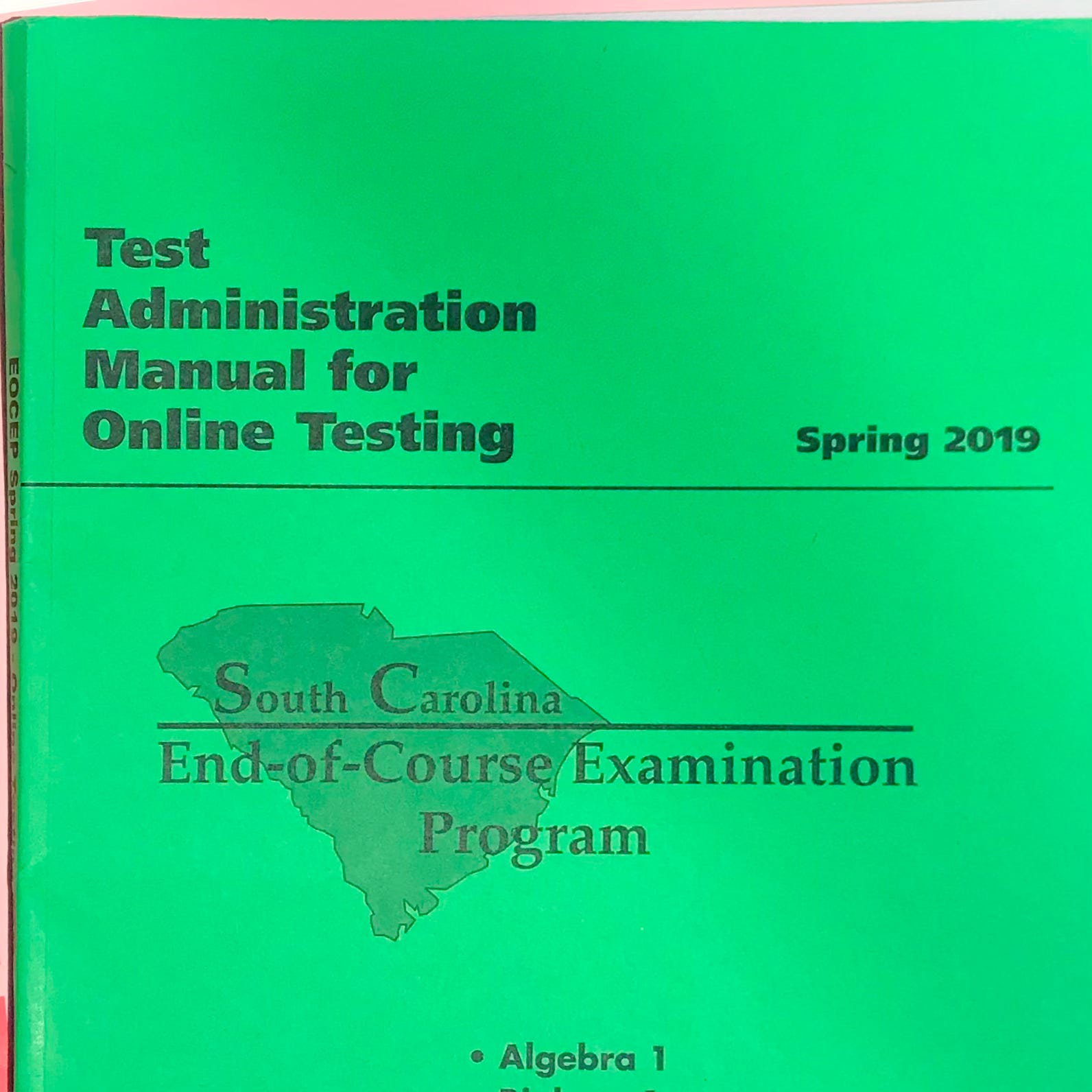
The day a shooter murdered nineteen elementary school students and two teachers at Robb Elementary School in Uvalde, Texas, this week, my students spent the first half of the school day in state-required testing, which continued for the rest of the week. Each test is accompanied by a Test Administration Manual (TAM) that is as thick as a paperback novel. Students may not talk during the test. They may not read when they are done (although, thankfully, this year they were allowed to return to class if their teacher wasn’t administering a test). They may not discuss the test afterwards. They most punch in and out for a bathroom break like warehouse workers.
In recent years, the tests have been computerized. One of my students once took it on a school-issued Chromebook off of which she had accidentally broken the J button, so as she typed up an essay— probably on an inane topic like why pizza is an artform— she had to insert the tip of her pencil into the keyboard every time she wanted to type the letter. (We had, appropriately, as it turns out, just read “The Metamorphosis,” Franz Kafka’s great novella about literal dehumanization following the figurative dehumanization of a mechanized, work-obsessed culture. I told students after the test that taking a test where you have to use a pencil tip to type ever fifth letter is the most Kafkaesque thing I’ve ever seen.) Many students struggle to stay awake during the test, which is untimed and generally takes from the very beginning of the school day until around lunch for everyone to finish. I once had a student who was so tired that when he clocked out to take a bathroom break he ran into the door frame on his way out like a drunk person at last call.
Before the tests were computerized, when I taught middle school, I had student who was ill on test day, and who threw up all over the desk, the floor, and the test booklet about half an hour into the test. I’m not sure what the rules were that year, because although the current TAM requests that schools “not return damaged documents to the contractor” in the case of student illness (this may be a post-COVD change), that year the assistant principal of the middle school had to come and carefully bag up the student’s vomit-soaked test booklet and bag it in a special bag from the testing company. Presumably he had to ship it back to them in the name of test security. Meanwhile, other sixth graders had to remain silent and continue to test as the smell of illness filled the room and the sick student sat in the corner.
The state test tells us a lot more about our real educational priorities than talk about “mental health” ever has, because on standardized tests, unlike on mental health or gun violence or pandemic mitigation, we actually take action. While neither federal nor South Carolina laws create a hard cap on class sizes (SC technically has a class size cap, but overrides it every year by proviso), a required student-teacher or student- counselor ratio, or even a requirement that every school have a nurse on staff, state and federal law explicitly require standardized tests. Specifically, the federal law is ESSA, the poorly-named “Every Student Succeeds Act,” an Obama-era reauthorization of No Child Left Behind, which was in turn a reauthorization of the Elementary and Secondary Education Act (ESEA). Specifically, according to the South Carolina Department of Education, ESSA requires states to (quoting directly from the SCDE website)
test students in reading or language arts and mathematics every year in grades 3-8 and once in grades 9 through 12
test students at least three times in science, once in 3-5, once in grade 6-9, and once in grades 10-12
administer an English language proficiency assessment to English language learners in grades K-12
administer alternate assessments for students with the most significant cognitive disabilities
Although legislators defending themselves against the charge that we over-test students often try to shift the blame to the feds, SC goes further than the ESSA requirements by also requiring all of the following (again quoted directly, weird typos and all, from the SCDE website):
SCPASS Social Studies in grades 5 and 7 (SC Code 59-18-310). In Fiscal Year 2021-22, the provisions of Section 59?18?325(C)(3) requiring social studies standards?based assessments of students in grades five and seven are suspended.
Ready to Work (R2W) Career Readiness Assessment in grade 11 (SC Code 59-18-325)
U.S. History and the Constitution End of Course Exam (SC Code 59-18-310)
Pre-K Readiness Assessments (SC Code 59-155-150)
Kindergarten Readiness Assessment (SC Code 59-155-150)
G&T Achievement and Ability tests (currently: Iowa Assessment and CogAT) (SC Code 59-29-170 & SBE Regulation R43-220)
G&T Performance Tasks (SC Code 59-29-170 & SBE Regulation R43-220)
SCPASS Science in one middle school grade (grade 6 or 8) (SC Code 59-18-310). In Fiscal Year 2021-22, the provisions of Section 59?18?325(C)(3) requiring science standards?based assessments of students in grade eight are suspended.
College Entrance Examination OFFERED (The ACT or SAT) in grade 11 (SC Code 59-18-325)
Perhaps aware that standardized testing has become more and more unpopular in recent years (because it expensive, takes up a lot of instructional time, is anxiety-provoking for students, leads to teaching to the test, generally tests simplistic skills that don’t always reflect what we want students to be able to do, is prone to racial, class, and gender bias, etc.) SC politicians have occasionally feinted at reform, but not in any concrete way. One of SC’s few education champions in the Senate, Mike Fanning (whose district was— probably fatally, for his reelection prospects—redrawn in the most recent round of state gerrymandering) has introduced variations of a bill each year to reduce testing. Predictably, it died in committee without any serious hearings this year, as it has in past years. Senator Shane Massey acknowledged several times during hearings on the probably-destined-to-pass ALEC school voucher bill he sponsored, S. 935, that the average state test “may be poor, it may be bad,” but also defended the test by saying at least everyone takes it (although, notably, not private school students).
In the same part of those hearings, he also said this:
Officials who support some or all of the testing generally explain the amount of testing we do by arguing that it’s for “accountability,” which, if you follow South Carolina politics, you may find hilarious. This is, after all, a state with such an understaffed and toothless Ethics Commission that public officials can often simply refuse to pay fines, and can escape punishment for even more serious offenses. This is a state that has resisted every effort to regulate guns, even as guns have become the leading cause of death for children in our country. In the last session, the state legislature passed an extremely lenient open carry law that came into effect during the first month of the school year, and which coincided with off-the-charts gun sales. The City of Columbia rolled back its gun restrictions under pressure from the NRA (something Columbia Mayor Daniel Rickenmann acknowledged openly) and from SC Attorney General, and fan of preventing municipalities from doing anything to defend themselves from problems the state won’t address, Alan Wilson.
The only conclusion I’ve been able to draw (and I’m not alone) is that South Carolina lawmakers don’t really give a damn about student mental health, or school improvement, or accountability. What they do give a damn about is ceding to the political pressure from a very powerful school privatization lobby. This lobby is to education “reform” what the NRA and associations of gun manufacturers are to gun regulation. One favor Betsy DeVos did by getting appointed as Superintendent of Education is that she gave a public face to a powerful, amoral, and often recklessly destructive set of rich people who are obsessed with creating private, often for-profit school systems that put money back into the pockets of wealthy parents and educational service providers while reducing the amount of taxes that actually make it into the community.
Meanwhile, South Carolina, in 2021, has seen its highest number of school shootings in 47 years, according to the Post and Courier. As of this writing, there have been at least 81 publicly-reported school weapons incidents this school year (most involving loaded guns. two involving students shot, and one, which prompted no state level action, leading to the death of a 12-year-old middle school student). According to teachers in multiple districts, this is likely a significant undercount, because many school weapons incidents are handled internally and never make it to the news media. The most recent two incidents happened this week, after the Texas shootings, the first when a seven-year-old elementary student brought a loaded gun to his school, and the second when a former high school student brought a loaded gun to school, in an uncomfortable echo of some of the details in the Texas massacre. Thankfully, no one was hurt—this time.

I certainly don’t pretend to have all the answers (or maybe even the right answers) as to how we reduce gun violence in our schools, but the popular talking points among our more loud-mouthed officials just aren’t going to do it. I’ve heard a lot recently about school resource officers being the solution, despite the fact that there is a growing body of reports that SROs in Uvalde were largely ineffective at either stopping the killer from entering the building or at entering the building to save the victims. In my own experience, with respect to a few truly kind and effective school resource officers, SROs are rarely the solution. I once worked in a middle school where the students were able to take the officer’s baton from him and beat him with it. At another school, students reported incidents of sexual assault to the resource officer, and received a lecture from the officer (notably not an attorney) on how they could be held legally responsible for libel for making the report. In Uvalde, it increasingly seems like the school resource officer didn’t engage with the killer at all, and had little impact on the outcome.
While the persistent belief that more SROs will prevent violence is at least understandable, the speed with which politicians broke out the old talking points about arming teachers is frustrating and unforgivable. For example, Senator Joshy Kimbrell, a man who added an amendment to the state budget to censor books in school libraries (here’s a screenshot of his initial proposal from SCEA) and who helped write a prohibition against “CRT” into the budget last year, was perhaps the most ridiculous person to champion the idea that school staff— who he doesn’t trust to select books or teach content appropriately— should now be armed (as long as they have a Concealed Weapon Permit). Notably, getting a CWP in South Carolina can cost almost nothing and requires a course that can be completed in as little as a day. The idea that this would qualify someone to not only securely and safely carry a deadly weapon around children (remember, the SRO at one school couldn’t even securely and safely hold onto his night stick), but engage a deadly shooter (something multiple police officers couldn’t do in Texas) is outrageous and insane.

A less crazy but probably ineffective idea that seems to be taking hold is the implementation of metal detectors at schools. The research I have read on these (which is admittedly not a great deal) does not seem promising, and anecdotally, I don’t see how they would do much. Modern schools have a lot of entrances and exits, and while people who love to shoot of at the mouth on important safety issues may believe otherwise, they need most of those entrances and exits. A metal detector will only be as effective as the school’s ability to staff it, the amount of time it is in effect (before school? after school? during transitions? during ever class?). For all the reasons we don’t have counselors, nurses, social workers, and teachers, we probably won’t have staff to use metal detectors either. Nonetheless, I predict they’ll be the plexiglass shields of the latest school shooting response.
Obviously, what I believe will work is what works in other countries: reduce who has guns by requiring registration and background checks, reduce the kinds of guns by making it harder to sell kits to make guns automatic, encourage people to lock up their guns and hold them responsible for when they don’t and reduce the amount of weapons/ ammunition a person can buy at one time. My father and brother, both gun enthusiasts (my dad was an NRA member in childhood and may own more guns than he can count, though none of them assault weapons), agree with me on these.
So against this backdrop, my students were taking a test created by a company called “Data Recognition Corporation,” which is what I would call the testing company if I wrote a satirical novel about a Kafkaesque journey into the dehumanizing effects of the standardized testing industry. The testing manual for our state test contains four full pages of warnings and legal citations about the consequences of violating test security. One of the sections quotes S.C. Code Ann. § 59-1-445 (2004): “Any person violating the provisions of this section or regulations issued hereunder is guilty of a misdemeanor and upon conviction must be fined not more than one thousand dollars or be imprisoned for not more than ninety days, or both. Upon conviction, the State Board of Education may suspend or revoke the administrative or teaching credentials, or both, of the person convicted.” South Carolina is one of only two states that refuses to pass a hate crime bill, but we’ve made it clear how we feel about the sanctity of proprietary test content from a private, for-profit company.
I have no idea how much testing costs each year in our state, but for the tests DRC creates, it received an initial (and somewhat controversial) contract from the state for $34 million. There is no federal requirement that school districts use expensive tests— or even tests, as we know them. ESSA even has a procedure for states to request waivers to allow them to adopt other measures of student progress, so presumably we could use a portfolio of work, a capstone project, or a test from an established testing company. The state has never requested this kind of waiver, though Jim Rex did request a Title I waiver in 2009, and Molly Spearman requested a temporary waiver from testing requirements due to COVID in 2020. (A request for a similar waiver in 2021 was denied, once again demonstrating the premium both state and federal governments place on testing, even during a worldwide pandemic.) Maybe we could save some of the money we spend on testing every year— and whatever amount that it is, I am sure it is an obscene figure— and spend it on nurses, or guidance counselors, or school psychologist, or teachers.
Related:
I’m going to try to keep these essays free (although that depends heavily on the job market now), but if you’d like to throw any support my way I do make music and it’s available here: Bandcamp (the discerning gentleperson’s choice) and other streaming services.
See similar content in much shorter chunks by following me on Twitter. If you haven’t subscribed, click the button below. It’s free!


